Do you really need a park nearby?
Two apartment options: a quiet courtyard by the metro with no greenery, or a park outside your window but no school or shop. The question isn't which is better — it's how you weigh that difference.

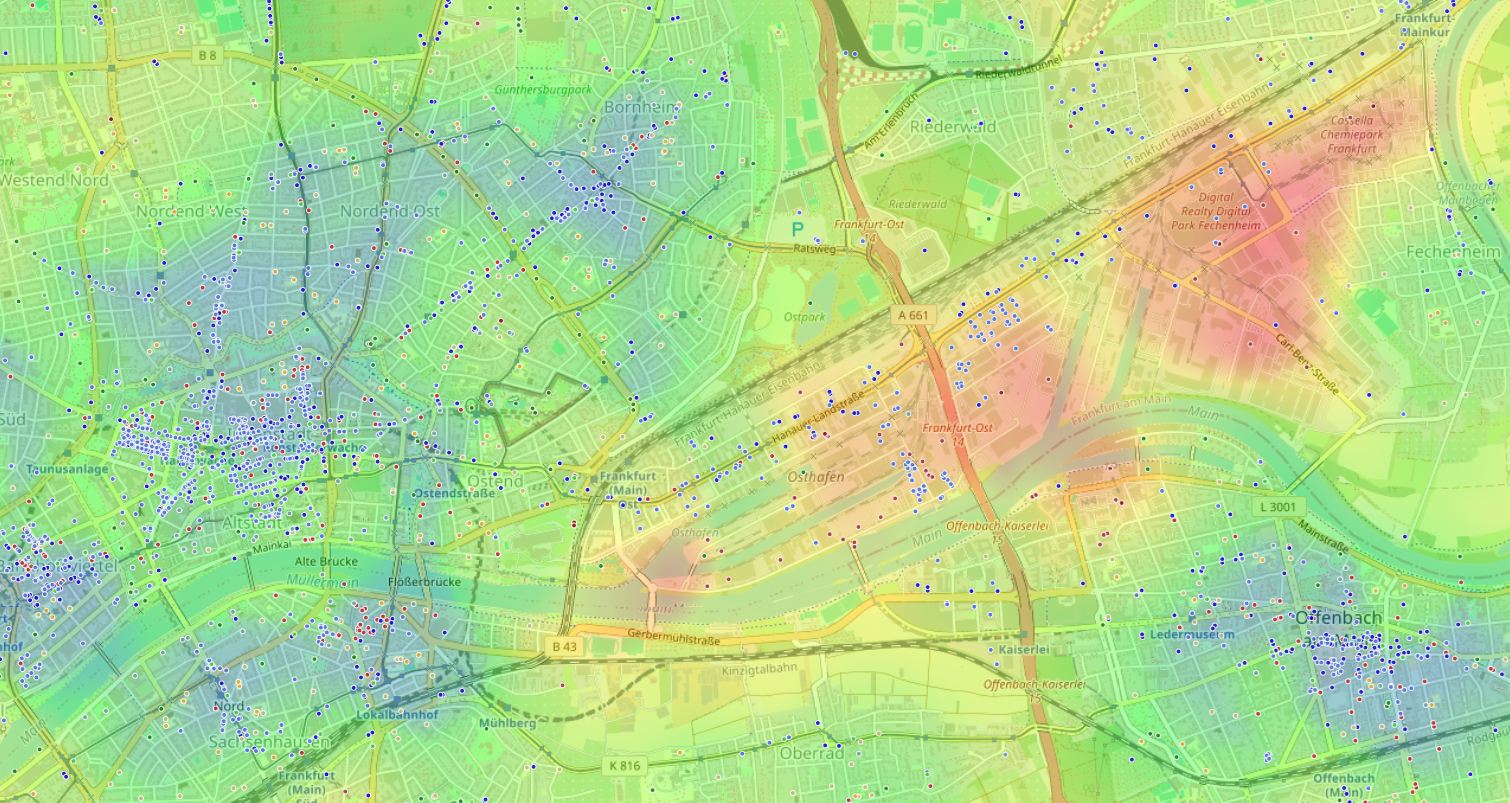
You're choosing an apartment — and you're offered two options
The first has windows onto a quiet courtyard, five minutes from the metro, but the nearest park is two neighborhoods away. The second is right by the water, greenery outside your window, squirrels in the morning. But the clinic, school, and a decent shop are already 40 minutes round trip.
The question isn't which is better. The question is — how do you actually weigh that difference?
In this article we'll explore why intuition almost always misleads you when choosing a neighborhood, and how to really measure the urban environment.
Why a park is more than just "nice"

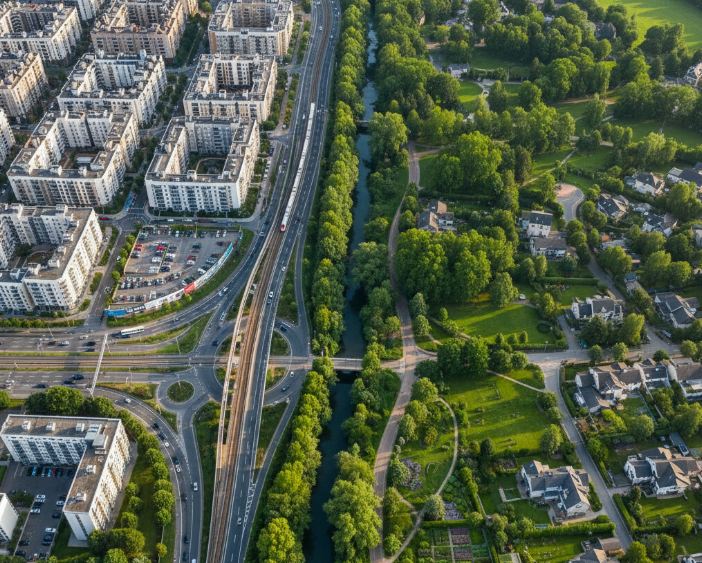
Urban planners stopped treating greenery as mere "city decoration" long ago. Parks, squares, and boulevards are infrastructure. Just like water pipes.
Research shows: people living within 300 meters of a green area report chronic stress 20–30% less often. But here's the paradox — the same effect comes from proximity to a good coffee shop, a lively market, or simply a busy pedestrian street.
It's not about the park. It's about the balance of your surroundings.
A city is an equation, not a list of addresses
Logistics time
How much of your week goes toward getting to the places you need.
Accessibility radius
What's actually nearby within walking distance.
Environmental balance
The ratio of positive and negative factors around a point.
Jeff Speck in Walkable City puts it this way: quality of life in a neighborhood is determined not by the presence of individual places, but by how they're connected to each other and to your daily route.
A park 15 minutes on foot is one thing. A park 15 minutes by bus with a transfer is a completely different equation.
Three things we usually don't count when choosing a neighborhood
Weekly logistics time
Say the nearest supermarket is a 12-minute walk. You go there three times a week. That's already 72 minutes a week — more than an hour. Multiply by a year. Charles Montgomery in Chronourbanism calls this "hidden time rent" — an invisible fee you pay the city every day.
Negative environmental factors
People look for cafés, schools, and the metro. But they rarely count what takes comfort away: noisy factories, nightclubs under the windows, transit highways. These factors aren't neutral — they actively reduce quality of life at a point.
Overall balance, not individual pluses
Three coffee shops nearby — good. But if there's also an abandoned factory, a nightclub, and not a single pharmacy — the final "score" can be negative.

"A good neighborhood isn't one where everything you need is present. It's one where nothing extra gets in the way of living."
How to calculate this in practice
Intuitive approach
- Walked around the neighborhood
- Looked at the map
- Asked friends
Analytical approach
- Assessed walking radius
- Calculated logistics time
- Accounted for negative factors
Manual analysis looks like this: you open a map, find all the places you need around an address, estimate distances, try to keep 10–15 factors in your head at once. It takes hours. And there's still room for error — because the brain handles multi-factor tasks poorly without visualization.
It's easier when the map calculates for you.
Look at your address differently
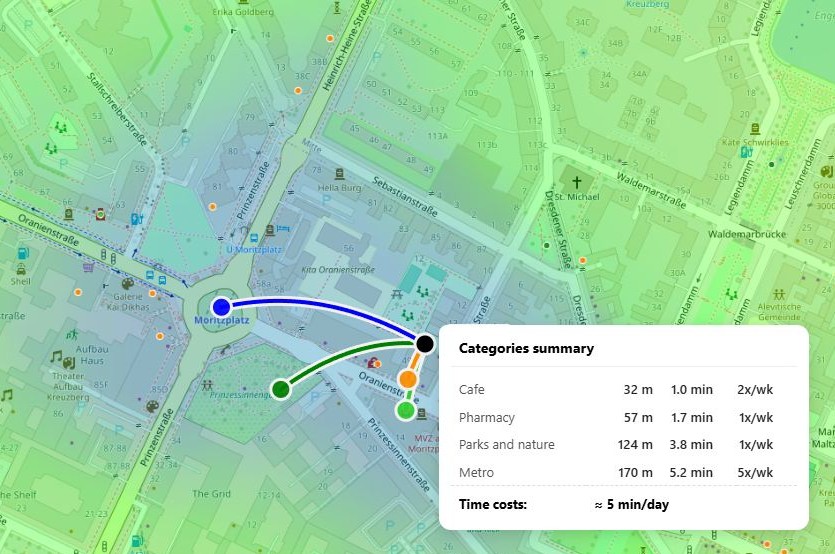
That's what HotMap is built for — a geographic information system that overlays a heat layer on the city map and calculates environmental balance for the categories you choose.
You choose what matters: parks, schools, cafés, metro — or conversely, you want to find a quiet spot far from nightclubs and factories. The system draws arcs to objects, calculates logistics time, and shows the final "score" of a point.
There are ready-made scenarios — "Quiet and calm", "Cultural center", "Nightlife" — or manual mode where you set the influence radius and weight of each factor yourself.
See how it works for your address
A park nearby is good. But it's not the answer
The urban environment works as a system, not a checklist. One park doesn't compensate for poor logistics. Three cafés don't offset noise pollution from a nightclub.
The real question when choosing a neighborhood isn't "is there greenery here", but "what's the overall balance of this point for my lifestyle".
And that balance is different for everyone.
Start simple: take your current address and honestly list everything within a 15-minute walk. Not just the good stuff.
Frequently asked questions
Do you need to live by a park to feel good in the city?
Not necessarily. Research shows that regular walking access to any lively public spaces — markets, boulevards, waterfronts — has a comparable effect. A park is one factor, not the only one.
How do you account for negative factors when choosing a neighborhood?
Most people simply don't count them — and then wonder about the discomfort. It's worth listing separately everything nearby that can get in the way: noisy venues, factories, transport interchanges. This is no less important than the list of pluses.
What is "logistics time" and why does it matter?
It's the total time you spend each week getting to the places you need — shop, work, school, doctor. Even a small difference in distance at high visit frequency turns into hours per month. When choosing housing, it's one of the most underrated factors.