What Actually Makes an Apartment Expensive
We unpack the hidden price mechanisms: time, walkability, environmental balance, and urban scenarios that listings don't show.

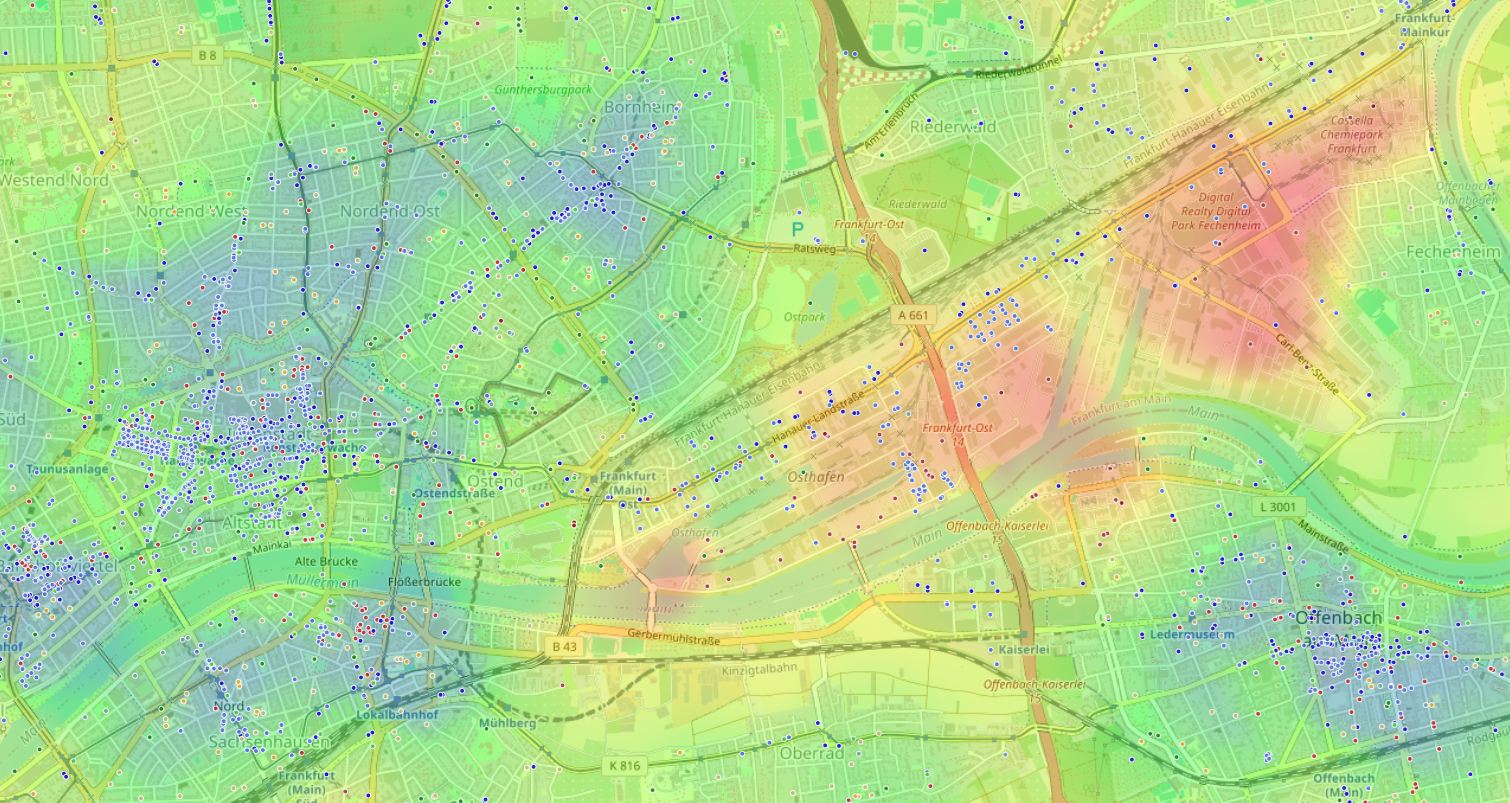
Same square footage doesn't mean the same value
Imagine two apartments with the same square footage in the same neighborhood, but one costs 30% more. Not because of finishes or floor level. What matters is what's beyond the front door.
Today we'll unpack the hidden pricing mechanisms and show you how to see them before you buy — while you're still choosing an address, not fixing the consequences.
You're not buying square meters — you're buying access to your life
Housing cost and access time
The closer key places are, the higher the price
The market is increasingly shifting from "square meters" to "minutes on foot," but listing language and mortgage calculators barely reflect this. Square footage matters, but everyday apartment value is built in routes to work, school, the park, the pharmacy, and your favorite coffee shop.
Ignore this shift and you may buy "affordable square meters" that eat two hours of your day in transit. In essence, developers aren't selling windows — they're selling the weekly time budget you'll spend moving.
"A happy city gives us back our time. An unhappy one steals it minute by minute."
Key takeaway: housing cost isn't shaped only by square footage, but by the time an address leaves you for real life.
Four factors that quietly drive the price tag
15-minute bubble
Price rises not from proximity to downtown, but from how many different functions you can reach within 15 minutes on foot.
Magnets and anti-magnets
Cafés, subway stations, and schools can be cancelled out by a highway, an industrial zone, or round-the-clock noise outside your window.
Walkability
It's not just how many meters to a destination, but the route you actually take every day.
If there's only housing and a main road nearby, you're paying for a bedroom community. If within the same radius there's a school, a square, a bakery, a coworking space, and a pool, you're buying urban concentrate.
Third places
Cafés, parks, clubs, libraries, and gyms create a sense that "life is happening here." That's what people are willing to pay extra for.
It's not the city center that sets the price — it's the palette of everyday scenarios
15-minute city research shows: each additional category of amenities within walking distance adds an average of 2–3% to the cost per square meter. But count categories, not points: five pharmacies won't replace a school, a park, and a grocery store.
True luxury is the ability to get through a day without a car and not lose variety. When the functions you need are nearby, an apartment becomes not an isolated box, but an entry point into a convenient urban network.
Key takeaway: address value isn't created by geographic prestige, but by the set of scenarios available without extra logistics.
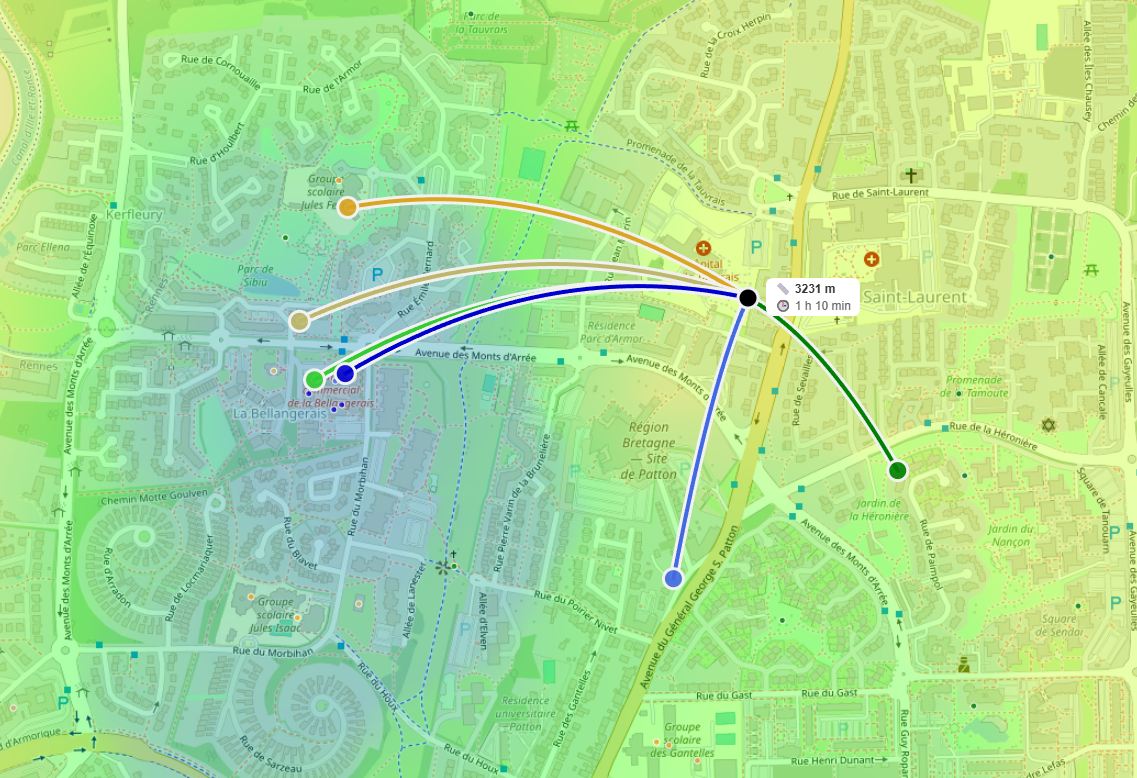
There can be plenty of infrastructure, but balance decides the outcome
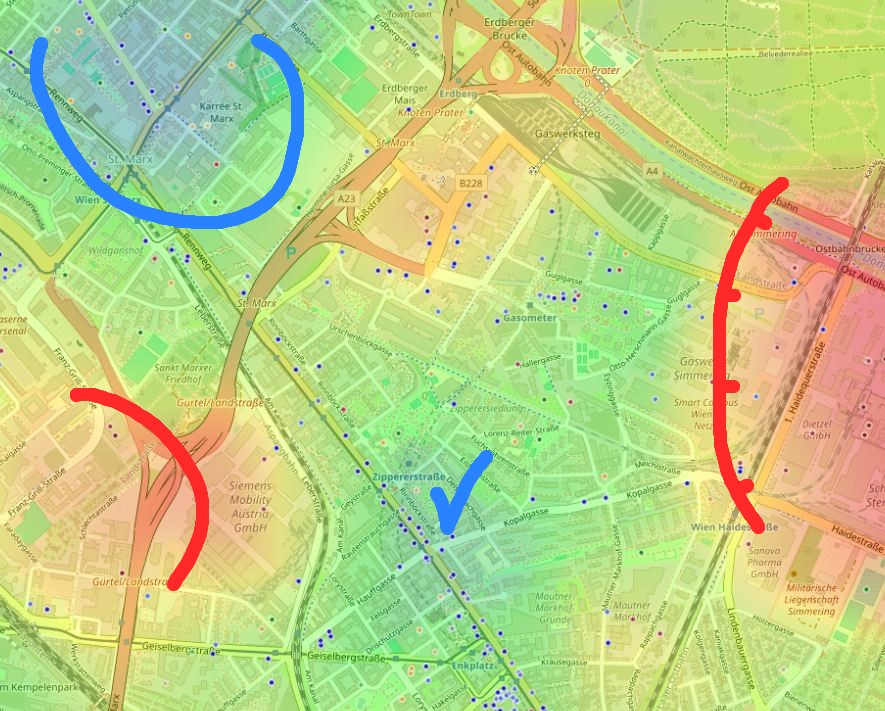
A common misconception: the more infrastructure, the better. In reality, a location's final appeal is an equation where positives can be wiped out by one strong negative.
We tend to notice objects individually, not their mutual influence. A heat map shows the real picture at once: where comfort is amplified, and where noise, odors, and vacant lots drain value.
Walkability: how you walk, not how many meters
Two buildings are 500 meters from the subway. The first is via a wide boulevard with benches. The second is through an underpass, a garage cooperative, and an unlit alley. Formally the distance is the same, but a pedestrian's brain rates the second route as 1.5–2 times longer.
Before accounting for this factor, you look at the map, see a circle, and feel pleased. After checking the route for sidewalks, crossings, and stairs, the "affordable" apartment may turn out to be a logistics trap.
Walkability checklist
- Sidewalk width over 2 meters
- Trees or rain shelters along the route
- Route is lit after dark
- No stairs without ramps
- No dead zones: fences and long blank walls
The invisible currency: third places
Work is the first place, home is the second. Cafés, parks, clubs, libraries, and gyms are third places where spontaneous social life happens. They boost not only mood, but also address liquidity.
Café with laptops
Remote workers aren't just buying an apartment — they're buying the right to work from several coffee shops within walking distance.
Park nearby
Even a small square can raise apartment prices around it by 8–12% if it's genuinely convenient to use.
Cultural hubs
Museums and theaters act as anchors for the creative economy and premium housing.
"An apartment without a third place is just a box with a bed. Life happens beyond the door."
How to evaluate a location on your own
To see the real cost of an address, replace the feeling of "seems convenient" with a short algorithm.
Outline your personal bubble
Open a map and draw an 800-meter circle around the address. Start by counting walking access only.
Count categories
List how many different types of places fall within the circle: pharmacy, school, café, park, grocery store.
Weigh the negatives
Find noise sources: main roads, industrial zones, loading yards. One anti-magnet can ruin the balance.
Calculate weekly time
Add up minutes to work, school, shops, and favorite spots by frequency. Anything above 5–6 hours is a risk signal.
"Before buying, I walked from home to the subway and shops for three days. The navigator showed 10 minutes, but it actually took 20: the sidewalk was blocked by cars. I chose a different location and saved myself an hour and a half a day."
From manual counting to visual analysis
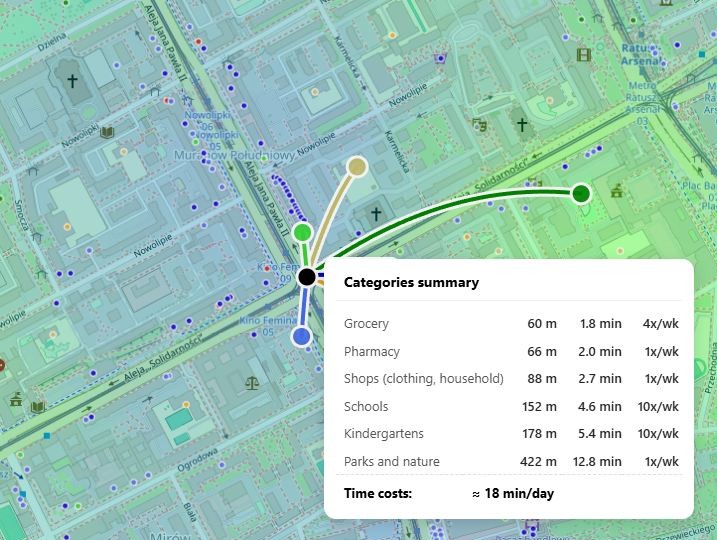
Everything described can be done with paper and a stopwatch. But collecting dozens of points, calculating magnet and anti-magnet balance, and building heat maps by hand is an evening-long project.
HotMap automatically overlays a semi-transparent heat layer on the map: green shows strong surroundings, red marks zones to approach with caution. The system calculates walkability and weekly time costs so your decision is data-driven, not gut-driven.
Check your location before signing the contract.
Summary: home begins beyond the threshold
Housing cost isn't just the price tag on the wall. It's the sum of minutes, impressions, and quiet you get every day. Stop measuring an apartment only in meters and start measuring it in time to what matters — and you'll see the real price and learn not to overpay for empty locations.
"An apartment isn't a box. It's a node in a network of urban opportunities. Check your network before signing the contract."
Frequently asked questions
Does HotMap account only for walking access, or transport too?
The system converts distance to any destination into time. You can set a profile for "walking," "driving," or "public transit" and see a realistic time budget.
Can I use the app for renting, not just buying?
Yes. The same rules apply when choosing rental housing: comfort and rent cost depend directly on environmental balance and time costs.
Where does data on cafés, schools, and parks come from?
HotMap uses continuously updated map data, and categories can be customized to your own priorities.