The Bedroom Community Trap: Why Your Address Steals Your Time
How the bedroom community phenomenon works, why it persists, and how to tell if you're living in one right now.

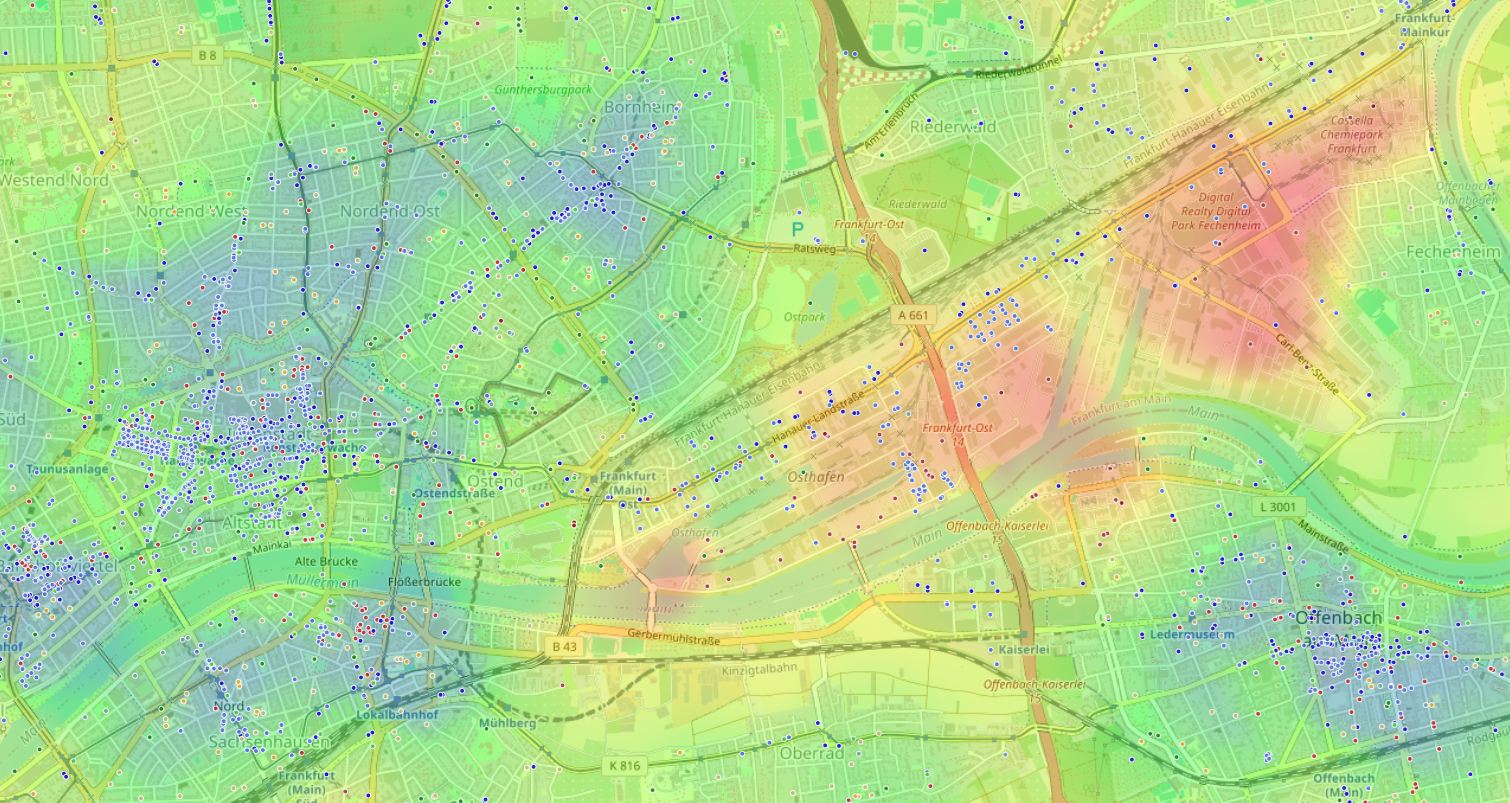
Are you living — or just sleeping?
Picture this: you get home at 8:30 p.m. The store is already closed. The pharmacy is two stops away. The nearest park is "well, about a twenty-minute walk." Everything you need exists — but none of it is here.
This is a bedroom community trap. A place that functionally goes by the name "home" — but in practice works only as a place to sleep.
In this article we'll break down how this phenomenon works, why it persists, and how to tell if you're living in one right now.

How cities turned into bedroom communities

In the mid-20th century, urban planners set out to solve what they saw as the main problem: divide the city into zones. Housing — separate. Work — separate. Retail — in specially designated areas.
The idea seemed logical. In practice it produced millions of neighborhoods where there's nothing to do, nowhere to walk, and no one to bump into by chance.
Jeff Speck in Walkable City calls this "an anthropological catastrophe in slow motion" — when the street stops being a place of life and becomes simply a route from point A to point B.
"Walkability isn't a convenience. It's the condition under which a city works as a city at all."
Today the trend is reversing — 15-minute city concepts, mixed-use development, active facades are emerging. But most people live in what's already built. And that "already built" often turns out to be a trap.
What is a bedroom community trap: the anatomy of the phenomenon
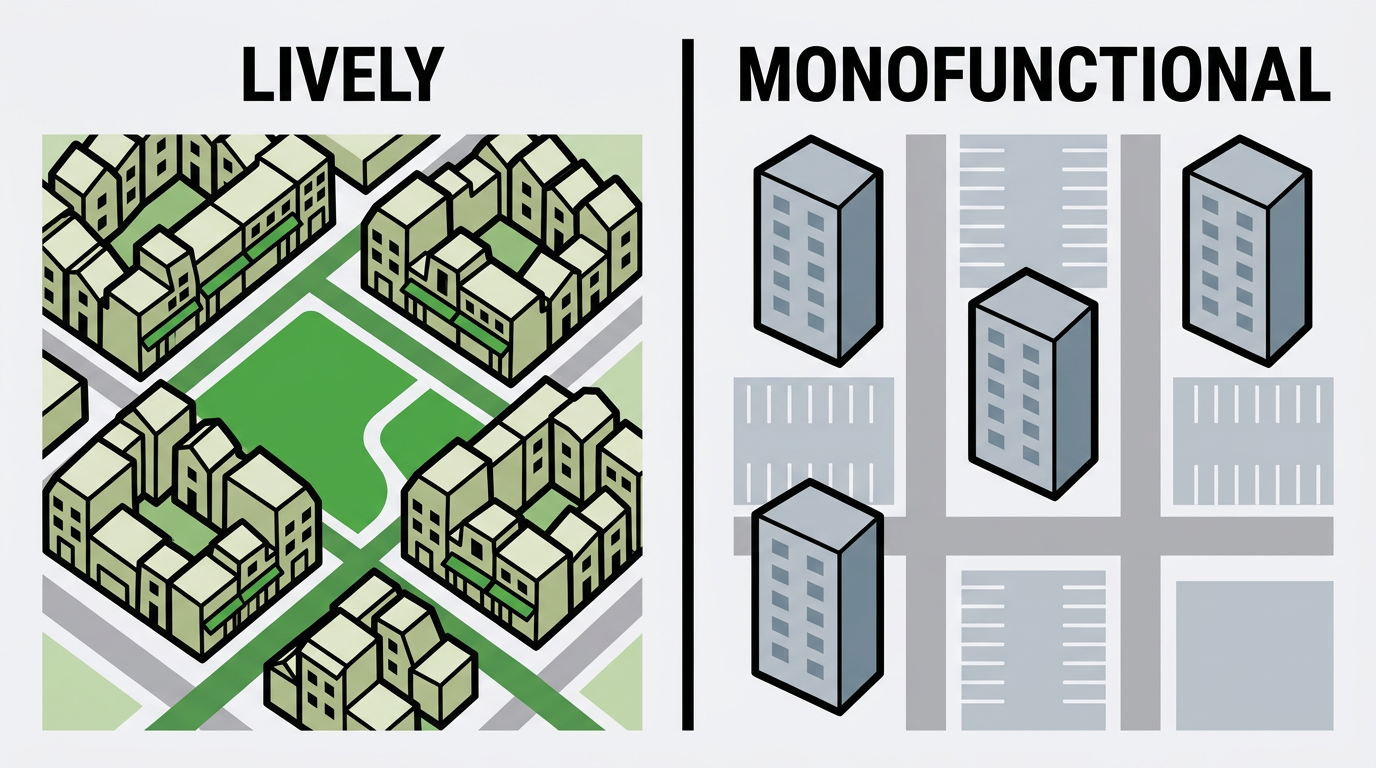
The word "trap" isn't an insult. It's a description of structure: a neighborhood that takes residents in at night and releases them in the morning. The rest of the time it's empty.
A bedroom community trap has recognizable traits. Below are five signs by which you can identify one.
Sign 1 — Monofunctionality
Housing takes up 80–90% of the area. Cafés — if there are any — one for the whole neighborhood. A grocery store — at best "near home," but not always.
Charles Montgomery in Happy City (the book was published under different titles, including Chronourbanism) describes it this way: when functions are spread across space, people spend resources — time, money, energy — just getting to ordinary things.
Key idea: a monofunctional neighborhood makes you pay for every step beyond your front door — with time or money.
Housing, parking, an occasional shop. Everything else — outside the neighborhood.
Home, café, pharmacy, square in one radius. Everyday errands — on foot.
Sign 2 — Logistical dependency
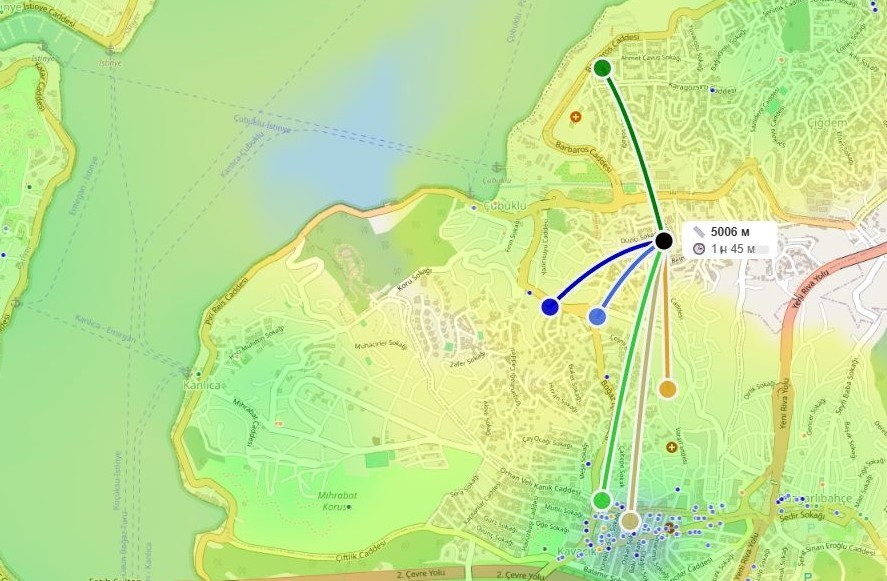
In a bedroom community trap you can't just "step out and walk." You have to drive. For food — drive. For medicine — drive. To take your child to an activity — drive.
This isn't just inconvenience. It's a structural dependency on transport that eats up an average of 1.5–2 hours a day for residents of peripheral neighborhoods in large cities.
The heat map shows how much time per week logistics "costs" a resident at a specific address. Red zones are neighborhoods with the highest costs.
Sign 3 — No spontaneity
In a living urban neighborhood, encounters happen: at the coffee shop, by the bakery, in the square. These chance crossings are the foundation of social fabric.
In a bedroom community trap there are no chance encounters. All routes are planned, all contacts deliberate. This doesn't just make the neighborhood boring — it gradually becomes anonymous.
"Streets stripped of life don't create calm — they create anxiety."
Sign 4 — Infrastructure exists, but not where you need it
The paradox of the trap: formally everything exists. There's a school. There's a clinic. There's a store. But the school is a 40-minute walk, the clinic has no convenient transport connection, and the store closes at 9 p.m.
Key idea: what matters isn't infrastructure on the map, but its real accessibility when you need it.
Exists on paper / inaccessible in practice
Exists on paper / inaccessible in practice
Exists on paper / inaccessible in practice
Why this matters — counting in hours
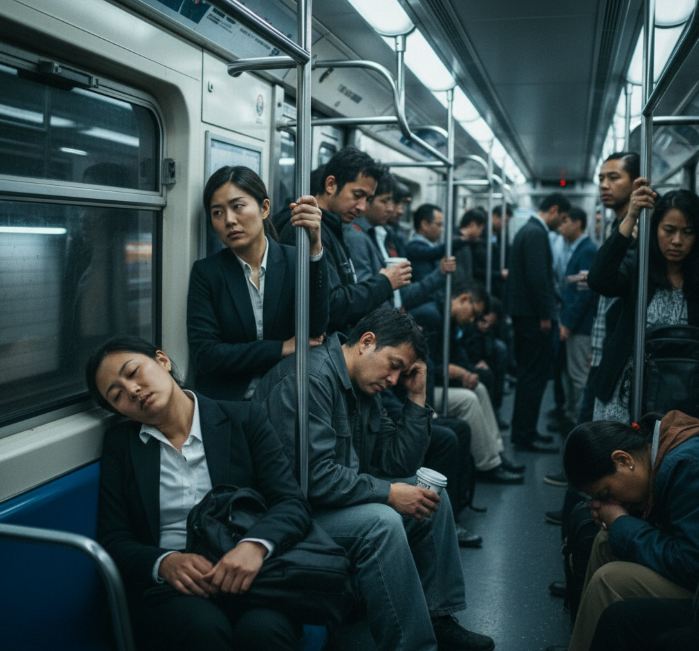
The abstraction "inconvenient" doesn't land well. Let's get more concrete.
If daily logistics eat up an extra 45 minutes — that's ~270 hours a year. More than 11 full days. Time that could have gone to sleep, exercise, children, projects.
This isn't philosophy. It's arithmetic.
"Time is the only resource we can't replenish. A city that steals it through poor planning literally steals life."
What this means in practice: every time you choose an address, you're not just choosing square meters — you're choosing how many hours per week you'll spend just getting to ordinary things.
What to do: how to evaluate a neighborhood before moving
Five steps that replace intuition with measurable verification.
Step 1 — Step out of your apartment mentally
Picture a typical day: morning, evening, weekend. Make a list of 8–10 places you go regularly. Pharmacy. Coffee shop. Gym. School. Park.
Step 2 — Check walkability
For each place on the list — time it on foot. Not as the crow flies on a map, but realistically: accounting for crossings, traffic lights, fences. 15 minutes on foot — comfort zone. 25+ — already logistics.
Step 3 — Calculate logistical losses
Add it up: how many trips per week, how many minutes each. Multiply by 52. That's your annual "logistics tax" in hours.
Step 4 — Check evening activity
Google the neighborhood at 7 p.m. on Street View. Or visit in person. Is the street alive?
Step 5 — Assess the balance of functions
Within a 15-minute radius, is there: food, greenery, coffee, pharmacy, at least one reason to go out without a purpose? If four out of five — the neighborhood works.
A map instead of intuition
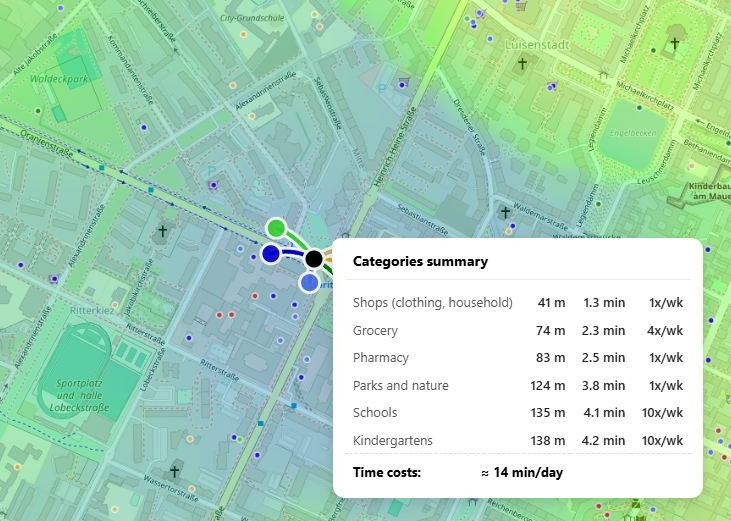
Everything described above can be done manually — on foot and with spreadsheets. But if you want to see a neighborhood's balance as a whole without spending a day checking every point — look at HotMap.
The service overlays a heat map on the real urban environment: it shows where useful amenities concentrate, calculates logistical losses from a specific address, and visually separates "living" zones from empty ones.
Gradient from red (infrastructure deficit) to blue (rich environment). You can immediately see where a neighborhood lives and where it merely exists.
Bottom line: an address isn't just coordinates
A bedroom community trap isn't a life sentence or a question of wealth. It's a structural choice that affects how much free time you actually have, how connected you are to the city, and how you feel every evening.
A good neighborhood doesn't have to be downtown. It has to be alive: letting you walk to what you need, bump into someone by chance, go out without a reason.
Next time you choose an address — count not just meters and floors. Count hours.
Frequently asked questions
Can you "fix" a bedroom community — or is it forever?
The environment changes slowly, but it changes. Opening one right business, redeveloping ground floors, a market or coworking space appearing — all of this gradually brings a neighborhood to life. Tracking the dynamics is useful if you're considering the area as a long-term investment.
Does walkability matter if I have a car?
A car solves logistics but doesn't create life. Research shows: residents of walkable neighborhoods know their neighbors more often, experience chronic fatigue less often, and rate their quality of life higher — regardless of income.
What matters more: proximity to downtown or the quality of the specific neighborhood?
Neighborhood quality. Many active and convenient areas are far from the historic center. And conversely — some central addresses structurally work like traps: expensive, but empty in the evening.